

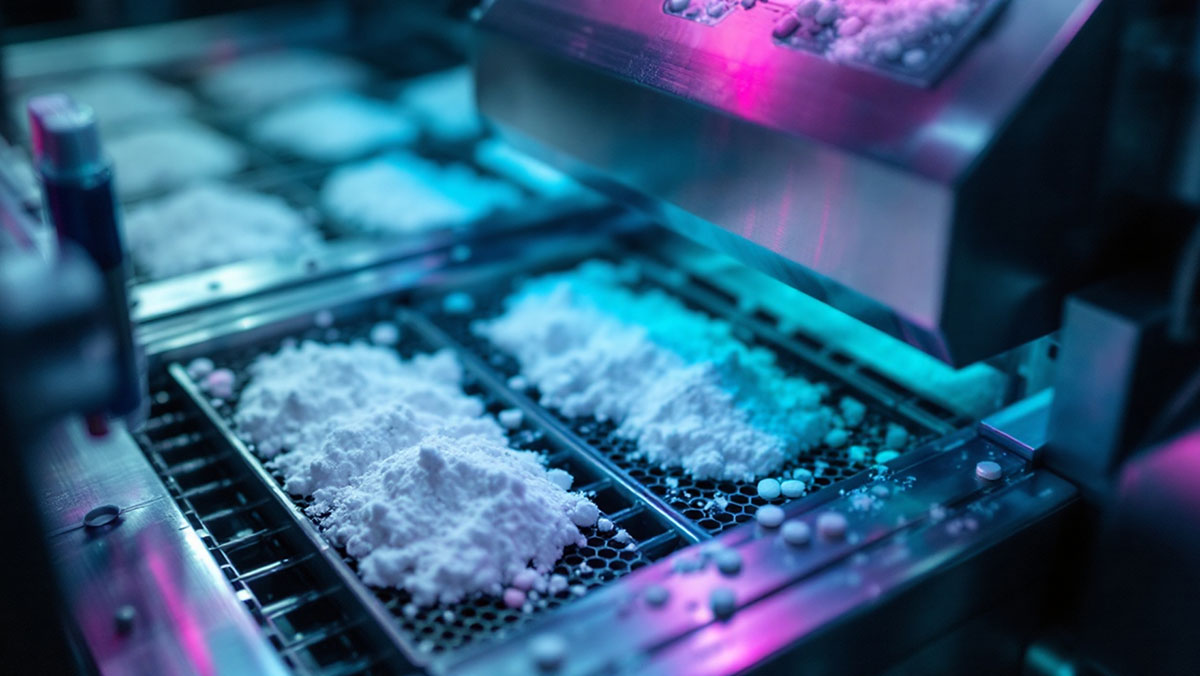
Bulk Lyophilization Opens New Paths for Non-Invasive Drug Delivery
Oral administration is the most desirable method for delivering therapeutics. It offers greater patient comfort and convenience, reduces treatment barriers, and improves adherence, advantages that translate to better clinical outcomes and lower overall healthcare costs. Oral formats also:
- Eliminate the need for sterile fill–finish
- Reduce reliance on cold-chain logistics
- Enable scalable, globally distributed products
- Increase patient comfort and autonomy
- Improve treatment adherence and outcomes
Despite these benefits, most peptides, proteins, and other biologic therapeutics remain limited to injectable formats. The barrier lies not in human physiology alone, but in manufacturing feasibility. The processes traditionally used to produce powders and granules for oral dosage forms, spray-drying and hot-melt extrusion (HME), were developed for small molecules that tolerate high temperatures and solvent exposure. These methods impose intense thermal and interfacial stresses that denature proteins and peptides, destroying their activity before a viable solid can be made.
Injectable formulations, by contrast, circumvent those stresses entirely. Most biologics are filled as aqueous or buffered solutions under aseptic conditions, sterilized by filtration rather than heat. This preserves the tertiary and quaternary structure, allowing for clinical delivery even of extremely fragile molecules. Biologics are stable enough to be injected, but too sensitive to endure the manufacturing required for oral or mucosal formats.
Bulk lyophilization offers a way to break that impasse. By removing solvent through sublimation at low temperature, it stabilizes biologics and peptides without denaturing them. It also enables these actives to be co-lyophilized with excipients or absorption enhancers, producing uniform, stable solids that can later be tableted, encapsulated, or formulated for oral, nasal, or buccal delivery, routes long considered out of reach for fragile APIs.
GLP-1 Receptor Agonists Reveal the Way Forward
The recent success of oral GLP-1 receptor agonists, such as semaglutide, has redefined expectations for what can be achieved in peptide delivery. For years, these drugs were considered viable only as injections because of their size, fragility, and rapid enzymatic degradation. The turning point came when formulators combined peptide stabilization strategies with absorption enhancers that transiently increase epithelial permeability.
Oral semaglutide, for instance, pairs the peptide with the absorption enhancer SNAC (sodium N-[8-(2-hydroxybenzoyl) amino] caprylate) in an enteric-coated tablet. The result is a stable, bioavailable oral dosage form that delivers meaningful systemic exposure without needles.
While the semaglutide formulation does not use lyophilization, its underlying principle demonstrates the opportunity: peptides can be orally bioavailable when protected and co-formulated with suitable excipients and permeation enhancers.
Other Examples of Lyophilization-Enabled Peptide Delivery
The same principle extends well beyond GLP-1s. Lyophilization has been used to stabilize other injectable-only peptides, including insulin, calcitonin, and parathyroid hormone analogues, into formats suitable for oral or nasal delivery. In these cases, freeze-drying was essential to preserve structural integrity, enable solid-state formulations, or extend shelf life. It has also been applied to monoclonal antibodies and vaccines for mucosal routes, such as nasal sprays and buccal films, where rapid dissolution and local or systemic uptake are desired.
| Drug / Molecule | Delivery Route | What Lyophilization Enabled | Citation |
| Insulin | Oral (enteric capsule) | Allowed insulin-loaded nanoparticles to be filled into an enteric-coated capsule without disrupting their structure, preserving pH-triggered release in the intestine and achieving ~20% bioavailability and glucose-lowering effect via oral dosing. | Sonaje et al. (2010) |
| Salmon Calcitonin | Oral | Allowed formation of a stable salmon calcitonin–sodium triphosphate complex that resisted enzymatic degradation and provided sustained release (~3 weeks), enabling continuous therapeutic effect after oral administration. | Lee et al. (2010) |
| Teriparatide (PTH 1–34) | Intranasal | Provided extended room-temperature stability for a multi-dose intranasal formulation of PTH 1–34: the lyophilized peptide was stable for months in dry form and allowed a reconstituted nasal spray to remain usable for weeks. | Merutka et al. (2016) |
| Anti–SARS-CoV-2 mAb (AUG-3387) | Intranasal (dry powder) | Transformed a liquid monoclonal antibody into an aerosolizable dry powder, which could be sprayed into the nasal cavity to enable intranasal prophylaxis or therapy for respiratory infection. | Yu et al. (2024) |
| Salmonella typhi Ty21a (oral typhoid vaccine) | Oral (enteric-coated capsule) | Stabilized live attenuated Ty21a bacteria in an acid-resistant capsule, allowing them to survive gastric passage and induce protective immunity (≈67% efficacy over 3 years) after oral vaccination. | Levine et al. (1987) |
Practical Experience in Formulating for Non-Invasive Routes
While the scientific rationale for using lyophilization in oral and nasal delivery is compelling, practical implementation matters just as much. Formulating fragile biologics into non-invasive formats requires repeatable, scalable processes that preserve molecular integrity, yield consistent powder characteristics, and integrate smoothly into downstream steps like tableting, filling, or packaging.
In recent years, bulk lyophilization has been successfully applied to a range of non-parenteral dosage forms, including oral tablets, nasal powders, sublingual wafers, pulmonary dispersions, and even vaginal inserts. These formats serve different clinical and consumer use cases but share common requirements:
- Structural preservation of sensitive APIs
- Compatibility with permeation enhancers
- High surface area for rapid rehydration
- Powder flow suitable for downstream manufacturing
- Cycle design tailored for product integrity and yield
Freeze-drying can be tailored through excipient selection, freezing kinetics, and drying cycle design, to produce bulk powders suitable for a wide variety of delivery formats. More importantly, it offers a development pathway for biologics and peptides that might otherwise be locked into injection-only formats.
This is just one facet of how bulk lyophilization is redefining what’s possible. From stabilizing botanicals and live biotherapeutics to enabling high-yield processing of scarce or insoluble APIs, freeze-drying offers formulation scientists a powerful alternative to conventional methods.
Explore these capabilities in detail in our full whitepaper: The Case for Bulk Lyophilization.