

The global market for lyophilization equipment and services is projected to grow from roughly $5.4 billion in 2025 to more than $10.6 billion by 2033, a compound annual growth rate of nearly 9%.1 Within that broader expansion, the bulk lyophilization services segment is growing at a similarly robust 7.4% annually, with the global market expected to climb from $839 million in 2024 to over $1.37 billion by 2031.2
The less visible side of that trend is a structural imbalance. The demand for bulk lyophilization services has been building steadily, but the CDMO capacity to support it has not grown at the same pace.
A Specialized Capability That Most CDMOs Were Never Built to Offer
To understand the capacity gap, it helps to understand how the CDMO industry’s lyophilization infrastructure developed. Most facilities built their freeze-drying capabilities around a single, high-demand application: sterile injectable vials. Vial lyophilization is a well-established process with deep regulatory precedent, and CDMOs serving the biologics and sterile products market invested heavily in the equipment and validated processes it requires.
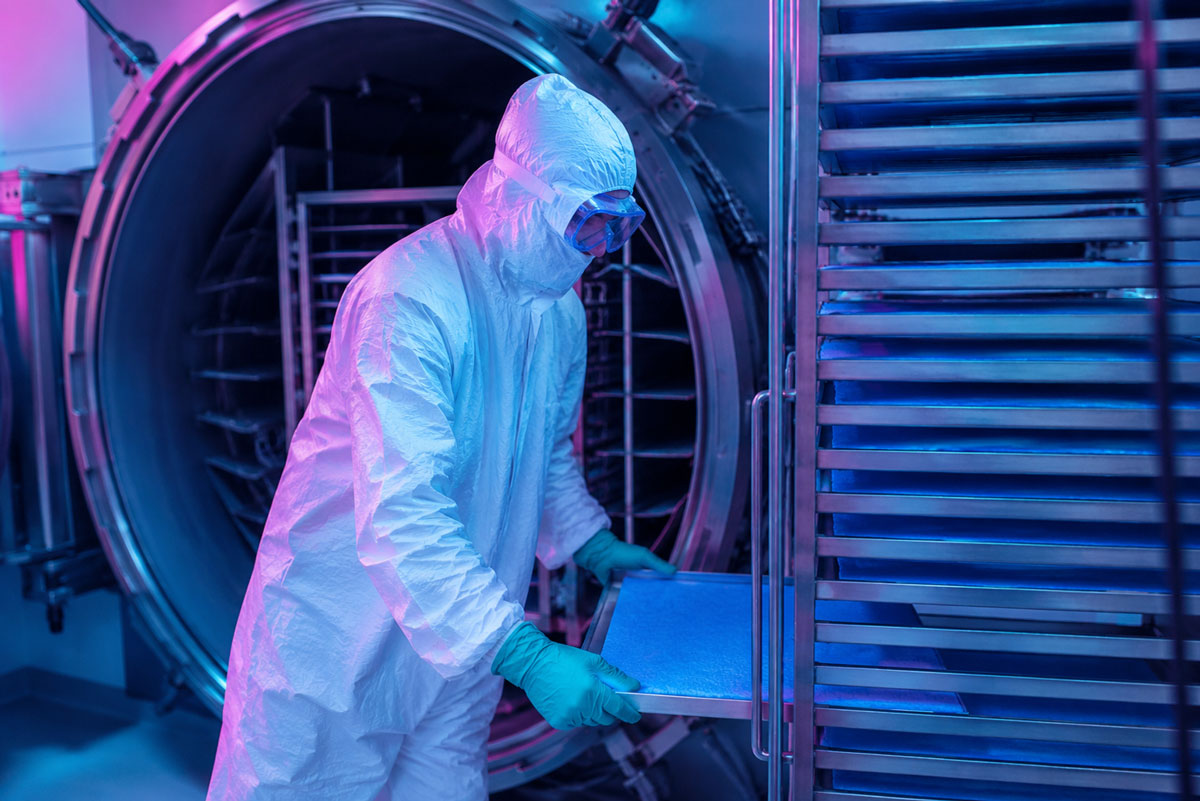
Bulk lyophilization operates at a different point in the supply chain entirely. Rather than drying product in sealed, single-dose containers for patient delivery, bulk freeze-drying loads material into open trays and produces dried API, intermediates, or ingredient powders for downstream processing. A facility configured for injectable lyophilization is not equipped for bulk tray drying, and the majority of CDMOs, including many with extensive sterile injectable infrastructure, do not offer it.
Adding it requires meaningful investment: specialized equipment, validated processes, and process development expertise that takes years to build. For CDMOs that had not seen strong client demand for the service, the business case was not compelling. Spray drying, hot melt extrusion, and vial-based lyophilization were meeting client needs for most programs. The result is an industry where bulk lyophilization capacity is concentrated in a small number of specialist facilities, and largely absent everywhere else.
Why the Demand Signal Is Growing
What has changed is the nature of the programs the industry is being asked to support.
Between 70 and 90% of drugs currently under development are classified as poorly soluble (BCS Class II or IV).3 Formulating these compounds for adequate bioavailability often requires producing an amorphous solid dispersion: the drug embedded in a polymer matrix in a high-energy, rapidly dissolving form.
Spray drying can produce amorphous dispersions, but it requires elevated temperatures and frequently involves harsh organic solvents. For thermally sensitive APIs, or those that require high-boiling solvents like DMSO to dissolve (solvents that spray drying cannot cleanly remove), lyophilization is often the more practical or only viable path.
Biologics and peptide therapeutics present a similar challenge. These molecules are structurally delicate and heat-sensitive; spray drying and hot melt extrusion, both of which rely on thermal energy, are typically incompatible with them. As the pipeline of oral peptide formulations, non-injectable biologics, and early-phase clinical candidates continues to expand, so does the need for lyophilization capacity beyond sterile injectables.
Live biotherapeutic products and probiotic-based formulations add further demand. Living organisms cannot tolerate heat; lyophilization is the established standard for preserving microbial viability through drying and across a shelf life.
Adjacent markets are compounding this further. Animal health, nutraceuticals, and consumer health are increasingly working with complex and sensitive active ingredients such as botanical extracts, live microbials, and enzyme-based formulations, many of which require the gentle, low-temperature processing that only lyophilization provides.
The cumulative effect is a widening range of programs pointing toward bulk lyophilization at a time when CDMO capacity for it has not grown in proportion to that demand.
What Happens When the Capacity Gap Closes In
The segment of CDMOs with genuine bulk lyophilization infrastructure is narrow, and only a small group of specialist providers globally are capable of supporting this work at scale. This is not a deep bench relative to the range of programs now pointing toward it.
The list stays short for structural reasons. Building bulk lyophilization capability requires specialized tray equipment, validated cleaning and loading procedures, and formulation development expertise distinct from what injectable lyophilization demands.
Spray drying has historically met the need for many programs where thermal stability allowed it, further reducing the incentive to invest in bulk freeze-drying infrastructure. Companies that have built it operate at high utilization, which means available capacity can tighten quickly when demand grows in a particular application area or molecule class. For drug developers and CDMOs evaluating their manufacturing options, this creates a meaningful supply chain risk.
Getting Ahead of the Gap
For drug developers, the most effective mitigation is early identification. If an API is poorly soluble, heat-sensitive, biologic-derived, or a live organism, bulk lyophilization should be on the formulation options list from the start, not identified as the only viable approach after other paths have been exhausted.
When evaluating CDMOs, it is worth asking explicitly about bulk and tray lyophilization, separate from vial lyophilization, including questions about equipment scale, batch experience, and formulation development capabilities. The two are not interchangeable, and most CDMOs with lyophilization infrastructure are equipped for only one of them.
For CDMOs fielding bulk lyophilization requests they cannot execute in-house, establishing a sub-contracting relationship with a qualified specialist before a specific project requires it is a considerably better position than searching for one under time pressure.
In both cases, the same principle applies: formulation strategy should drive technology selection, not the manufacturing capabilities a given CDMO happens to have on hand.
Where to Find True Bulk Lyophilization Capacity
OFD Life Sciences has been built around bulk lyophilization, not as an ancillary service but as a core capability developed over decades across pharmaceutical, biologic, nutraceutical, animal health, and consumer health applications. The formulation expertise, cycle development infrastructure, and manufacturing scale to handle demanding programs are in place.
Whether you are a drug developer working through a challenging API or a CDMO looking to subcontract a project that exceeds your in-house capabilities, the capacity gap does not have to determine your outcome.
Sources
1. Grand View Research. Lyophilization Equipment and Services Market Report, 2033. Global market estimated at USD 5.36 billion in 2025, projected to reach USD 10.63 billion by 2033 at 8.98% CAGR.
2. The Insight Partners. Bulk Lyophilization Services Market Size and Forecast to 2031. Market projected to grow from USD 839.19 million (2024) to USD 1,370.56 million (2031) at 7.4% CAGR.
3. Babu SR, et al. Advancement in Solubilization Approaches: A Step towards Bioavailability Enhancement of Poorly Soluble Drugs. PMC/NCBI, 2023. PMC10221903. Estimates 70–90% of drugs in development classified as BCS Class II or IV.