

Nutraceuticals occupy an unusual space. They are neither purely food nor fully pharmaceutical, sitting at a convergence point that combines nutritional value with targeted biological activity. That dual nature is both what makes them exciting and what makes them genuinely difficult to produce.
Nutraceuticals Demand a Different Kind of Processing
The promise of a nutraceutical product lives or dies at the molecular level. Polyphenols, live cultures, marine-derived bioactives, peptide-based functional ingredients, complex botanical extracts with multi-compound activity profiles: all of these are sensitive to the conditions they encounter during processing.
Spray drying, roller drying, and air drying each apply heat, and high heat is the enemy of biological complexity. Vitamins degrade. Enzymes denature. Probiotic organisms die. Botanical compounds oxidize and lose their efficacy profile before the product even reaches the shelf. The active ingredient you are trying to deliver is often the first casualty of the formulation process.
Lyophilization Preserves What Actually Makes a Product Work
Lyophilization (aka freeze-drying) works differently. By locking biological material into a stable, low-moisture amorphous matrix before degradation pathways can occur, the sublimation process preserves cell wall architecture, enzymatic activity, and the fragile molecular structures that define potency.
Direct comparisons between freeze-drying and heat-based drying methods have found measurably higher retention of bioactive compounds, including polyphenols, flavanones, and antioxidant capacity in lyophilized products, alongside a shelf life measured in years rather than months, without refrigeration.[1]
For nutraceutical developers, this distinction matters at the formulation stage as well as the production facility. The choice of drying technology shapes which active ingredients can survive processing, how potent they remain over time, and whether certain combinations of ingredients are even feasible to produce.
Table 1: Comparison of Industrial Drying Methods for Nutraceutical Applications
| Drying Method | Process Temperature | Bioactive Retention | Shelf Life (no refrigeration) | Whole Foods and Live Cultures | Cold Chain Required |
| Lyophilization | −40 to −20°C[2] | 78–97%[3] | years | Yes | No |
| Spray Drying | 150–220°C (inlet)[4] | 63–79%[3] | months – a year | limited | often |
Lyophilization Can Fuse Macro and Micro Nutrients into a Single Product
One of the most compelling frontiers in nutraceutical development is combining macro-nutrient delivery and micro-dose bioactive activity in a single format. For example:
- A protein-enriched functional food that also delivers a precise concentration of an anti-inflammatory botanical.
- A probiotic formulation co-processed with prebiotic fiber and immune-modulating peptides.
- A freeze-dried blueberry powder retaining its full anthocyanin and polyphenol profile.
This capability is the foundation of an even more powerful application: the co-formulation of nutritional and medicinal substances in a single product.
Conventional Drying Methods Run Into a Wall Here
Processing conditions that suit a macro-nutrient matrix may destroy a heat-sensitive micronutrient present at trace concentrations. Compatibility between components (their water activity behavior, their pH sensitivity, their differential thermal tolerance) becomes a formulation obstacle that forces compromises. Research reviewing drying challenges across nutraceuticals and biopharmaceuticals has identified these multi-component sensitivity mismatches as a core driver of product development complexity.[5]
Lyophilization largely overcomes this obstacle because the gentle, low-temperature process is kind to both ends of the concentration spectrum simultaneously. Macro and micro ingredients can be co-formulated, processed together, and stabilized in a single matrix without sacrificing one component’s integrity for another’s.
This fusion capability is central to where nutraceutical science is heading. Products are becoming more sophisticated, more targeted, and more biologically complex. The formulation platform has to keep pace.
Better Yield, Better Economics: The Cost Case for Lyophilization Is Improving
Lyophilization has historically carried a reputation as an expensive process, requiring capital-intensive equipment, longer cycle times relative to spray drying, and specialist process knowledge. For commodity nutraceutical applications, that perception has sometimes made the technology feel out of reach.
That picture is changing. As the technology matures and process optimization becomes more sophisticated, the economics shift. Because lyophilization can be optimized to target and retain the activity of a specific bioactive compound, less raw material is required to meet potency specifications, and fewer batches fail on stability.
Yield, Waste, and the Total Cost of Ownership
Yield, measured not just in mass recovered but in active compound recovered, is consistently higher than competing methods for biologically complex materials. This means that the more precisely a lyophilization cycle is designed around the target bioactive, the less it costs per unit of active delivered.
Factor in reduced spoilage, the elimination of cold-chain requirements, extended shelf life that opens global distribution channels inaccessible to refrigerated formats, and the premium product positioning that authentic bioactive preservation enables. The total cost picture looks quite different from a headline equipment comparison. The cost of producing high-quality lyophilized nutraceuticals is expected to continue declining as the science of process optimization advances, broadening access to the technology across the nutraceutical industry.
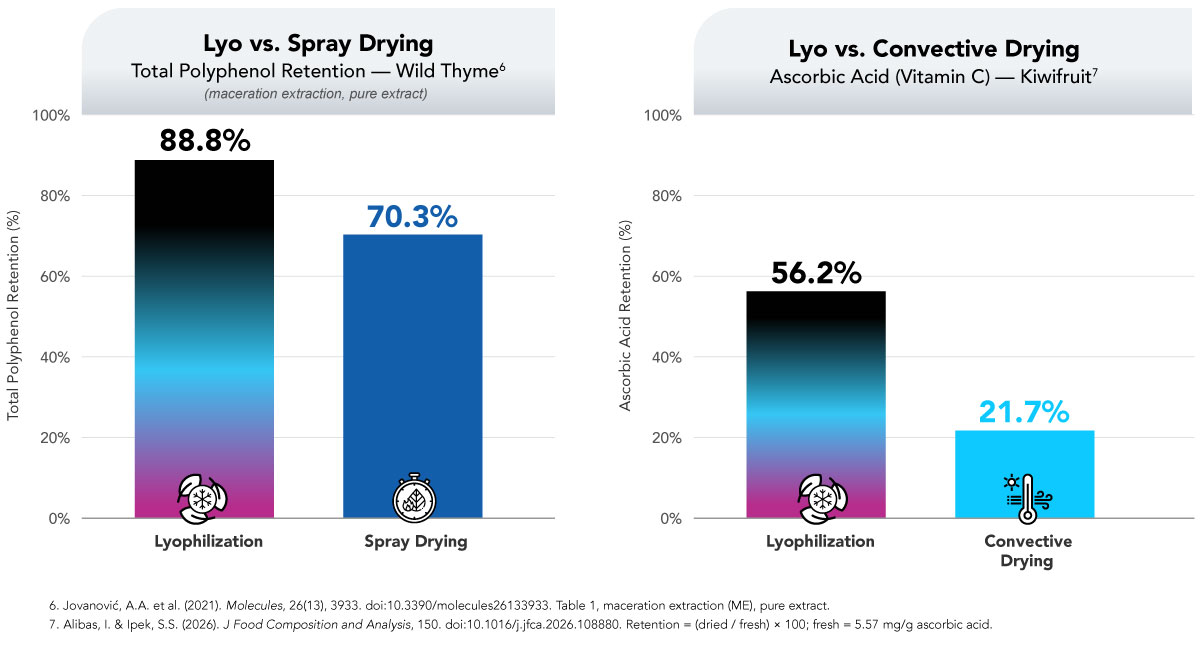 Figure 1: Bioactive compound retention by drying method. Left panel: total polyphenol retention — lyophilization vs. spray drying in wild thyme extract.[6] Right panel: ascorbic acid (vitamin C) retention — lyophilization vs. convective drying in kiwifruit.[7]
Neutramelt: Built for the Complexity of the Next Generation
OFD Life Sciences’ Neutramelt platform brings pharmaceutical-grade lyophilization science into the service of nutraceutical development. Purpose-built for the biological complexity of consumer health applications, it offers controlled drying parameter development, validated cycle optimization, and the process expertise to design a drying profile around a specific bioactive target rather than applying a generic approach. The result is a platform engineered to protect what makes each product work: whether that is a live culture, a botanical extract, or a co-formulated matrix of macro-nutritional and medicinal ingredients.
Neutramelt supports a broad range of nutraceutical applications:
- Dietary supplements and vitamins
- Functional food and beverage formats
- Probiotic and microbiome products
- Botanical and herbal extracts
- Marine-derived bioactives
- Animal health and veterinary supplements
OFD Life Sciences works with nutraceutical teams across the full development cycle, from early formulation support through process optimization and commercial-scale production. Whether building from the ground up, optimizing a product underperforming on stability, or seeking a manufacturing partner with the process expertise to handle biological complexity, the engagement starts with understanding the bioactive you need to protect.
Contact OFD Life Sciences and explore what lyophilization can do for your nutraceutical formulation.
References
- Kumar, D., Ladaniya, M.S., Gurjar, M., et al. (2022). Impact of drying methods on natural antioxidants, phenols and flavanones of immature dropped Citrus sinensis L. Osbeck fruits. Scientific Reports, 12, 6684. https://doi.org/10.1038/s41598-022-10661-7
- Bhatta, S., Stevanovic Janežić, T. & Ratti, C. (2020). Freeze-Drying of Plant-Based Foods. Foods, 9(1), 87. https://doi.org/10.3390/foods9010087
- Buljeta, I., Pichler, A., Šimunović, J. & Kopjar, M. (2022). Polysaccharides as Carriers of Polyphenols: Comparison of Freeze-Drying and Spray-Drying as Encapsulation Techniques. Molecules, 27(16), 5069. https://doi.org/10.3390/molecules27165069
- Murugesan, R. & Orsat, V. (2012). Spray Drying for the Production of Nutraceutical Ingredients—A Review. Food and Bioprocess Technology, 5, 3–14. https://doi.org/10.1007/s11947-011-0638-z
- Misra, N.N., et al. (2024). Advancement and Innovations in Drying of Biopharmaceuticals, Nutraceuticals, and Functional Foods. Food Engineering Reviews. https://doi.org/10.1007/s12393-024-09381-7
- Jovanović, A.A., Lević, S.M., Pavlović, V.B., Marković, S.B., Pjanović, R.V., et al. (2021). Freeze vs. Spray Drying for Dry Wild Thyme (Thymus serpyllum L.) Extract Formulations: The Impact of Gelatin as a Coating Material. Molecules, 26(13), 3933. https://doi.org/10.3390/molecules26133933
- Alibas, I. & Ipek, S.S. (2026). Effects of major drying methods on the stability and retention of vitamin C, B group vitamins, fat-soluble vitamins, and carotenoids in kiwifruits. Journal of Food Composition and Analysis, 150. https://doi.org/10.1016/j.jfca.2026.108880